
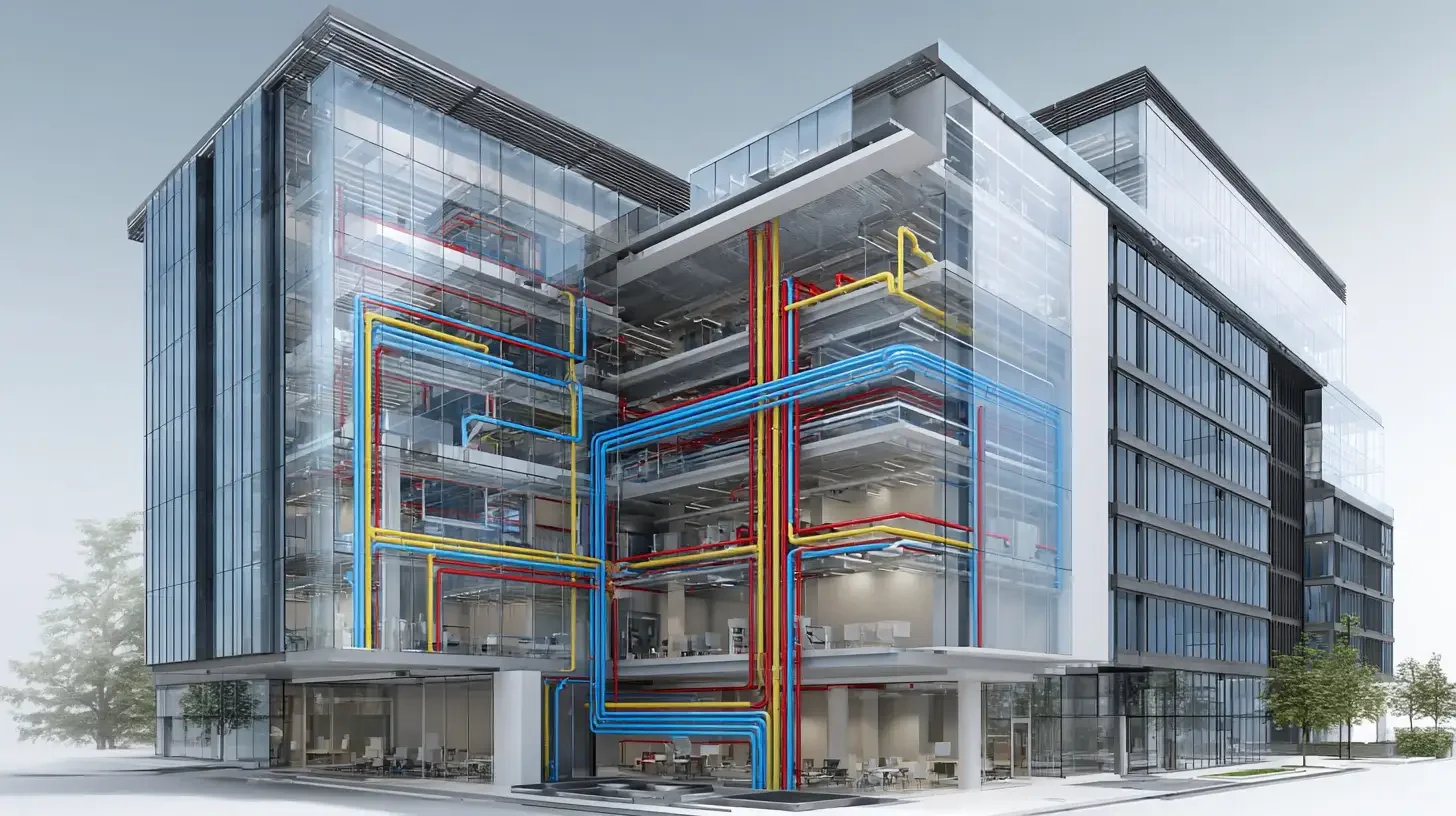
WHERE MOST PROJECTS STRUGGLE — MEPF BIM
BIM Professional Program For MEPF Engineers
MEPF BIM operates where complexity is highest - dense systems, tight spaces, and constant coordination across disciplines. MEPF BIM increasingly acts as a data source for construction, quality, and asset decisions - not just coordination
This program trains MEPF BIM professionals to build digital models that work across design, coordination, and delivery, enabling architects, engineers, trades, and project teams to rely on the model as a shared source of truth.
THE REALITY OF
MEPF BIM

MEPF BIM fails most often not because of software - but because systems are not modeled with coordination logic, hierarchy, and change in mind. Across real projects, teams repeatedly experience the same realities.

INFORMATION
&
DOCUMENTATION
Poor information leads to poor decisions and costly rework.


CONGESTED SPACES
Congested spaces expose weak MEPF BIM early in the project.

CLASH RISK
Everything clashes with MEPF first.

CHANGE IMPACT
Design changes cascade across services instead of being managed.

DRAFTING
VS MODELING
MEPF modeling is often treated as drafting, not as a system discipline.

SYSTEMS
IN ISOLATION
Systems are modeled in isolation, not as interconnected networks.

When these realities are not addressed early, MEPF BIM BECOMES REACTIVE instead of a system teams can rely on.
The Reality of MEPF BIM on Real Projects
MEPF BIM fails most often not because of software - but because systems are not modeled with coordination logic, hierarchy, and change in mind. Across real projects, teams repeatedly experience the same realities:
Everything clashes with MEPF first
Systems are modeled in isolation, not as interconnected networks
Congested spaces expose weak MEPF BIM early
Design changes cascade across services instead of being managed
MEPF modeling is often treated as drafting, not as a system discipline
Poor Information & Documentation
When these realities are not addressed early, MEPF BIM becomes reactive - instead of a tool teams can rely on.
What You’ll Work Through
System Setup & Intent
01
You begin by understanding what the MEPF systems are meant to achieve, not just where elements go.
You work through:
defining system boundaries and hierarchy
understanding spatial constraints early
aligning MEPF intent with architectural and structural context
This sets the foundation for everything that follows.
Multi-Discipline Coordination
02
MEPF BIM is tested when other disciplines come in.
You work through:
identifying and resolving coordination conflicts
responding to architectural and structural changes
adjusting systems without breaking logic or intent
This phase reflects real coordination pressure, not ideal scenarios.
Information & Data Readiness
03
You learn that MEPF BIM is not just geometry - it is information.
You structure models so they can support:
quantity extraction
quality and consistency checks
downstream construction and planning needs
asset and system information requirements
This phase trains you to think beyond the model itself.
Documentation & Delivery
04
You translate coordinated MEPF BIM into clear, dependable deliverables.
You work through:
aligning model information with drawings and schedules
ensuring clarity for installers and site teams
maintaining consistency as revisions occur
Documentation is treated as a delivery responsibility, not an afterthought.
Quality Control & Project Readiness
05
Before handover, you focus on readiness, not completion.
You learn how to:
review models for system integrity and clarity
check information completeness and reliability
prepare MEPF BIM that teams can trust moving forward
This phase reflects what professionals do before models are relied upon.
PORTFOLIO OUTCOMES — MEPF
What Your MEPF Work Signals to Real Project Teams
Your portfolio is not a collection of models. It shows how your MEPF BIM performs under real coordination, information, and delivery pressure. Employers don’t look for software proficiency here - they look for trustworthy MEPF BIM behavior.
-
Your work demonstrates MEPF systems that stay connected, logical, and buildable — even as coordination tightens and constraints change.
Teams see systems they can route, adjust, and rely on.
-
Your architecture supports engineers and trades with clear spatial intent and dependable information.
-
Our MEPF BIM contains structured, usable information that supports:
quantities
quality checks
construction planning
downstream documentation
This is where many models fail — and where yours stands out.
-
Your portfolio reflects MEPF deliverables that installers, coordinators, and site teams can read, trust, and act on.
Clear intent. Clear systems. Clear responsibility.
-
Reviewers see how you:
manage change without chaos
maintain consistency across systems
take responsibility for shared project information
This signals readiness for real project environments.
The Result A portfolio that tells reviewers one clear story: This person understands how MEPF BIM actually works on real projects — not just how to model it.
CAREER IMPACT — MEPF
Where MEPF BIM Capability Creates Real Project Value
MEPF BIM creates the most value where systems are dense, coordination is critical, and information must
remain dependable across teams, locations, and project phases.
What this signals: MEPF BIM capability is valued wherever systems, information, and coordination must work - regardless of geography.
Where MEPF BIM Capability Creates Real Project Value
01
MEPF BIM creates the most value where systems are dense, coordination is critical, and information must remain dependable across teams, locations, and project phases.
Design & Engineering Environments
02
Support system design, spatial planning, and coordination with MEPF BIM that reflects intent, constraints, and downstream use.
General Contractors & Project Delivery Teams
03
Contribute to constructability reviews, quantity workflows, and planning activities with MEPF BIM teams can rely on.
Owners, Developers & Asset-Focused Organizations
04
Provide reliable system information, quantities, and asset data to support planning, quality control, and long-term operations.
Specialist BIM, VDC & Digital Delivery Groups
05
Work within teams focused on coordination, information management, and model-based decision-making.
Global & Distributed Project Environments
06
Contribute MEPF BIM that remains clear, structured, and usable when teams are spread across locations and time zones.
AT A GLANCE
Program Snapshot— MEPF.


DISCIPLINE FOCUS
MEPF (Mechanical • Electrical • Plumbing • Fire)

LEARNING APPROACH
Project-based, system - first, coordination - aware

WHAT YOU WORK WITH
Coordinated models, system data, and delivery - ready information

HOW YOU LEARN
Guided journey with reviews, feedback, and real - world context

WHAT YOU GRADUATE WITH
A portfolio that proves system integrity, coordination maturity, and information reliability

WHERE IT APPLIES
Design teams, coordination environments, GCs, owners, and distributed project teams
Built to reflect how MEPF BIM is actually used across the AEC lifecycle.

Ready to Build MEPF BIM Teams Can Rely On?
If you want to move beyond isolated modeling and learn how MEPF systems, coordination, and information come together on real projects - this program gives you the structure, mindset, and project context to do exactly that.