

ARCHITECTURAL BIM THAT WORKS ACROSS THE ENTIRE AEC ECOSYSTEM
BIM Professional Program For Architects
Architectural BIM sits at the center of every project — connecting design intent, engineering requirements, trade coordination, and construction delivery.
You don’t just learn how to model. You learn how to deliver architectural BIM that other teams can depend on.
THE GAP BETWEEN LEARNING & PRACTICE
What Many Architectural Professionals Never Learn
Architectural BIM is expected to support far more than design representation. In real projects, architectural models become a foundation for coordination, communication, documentation, and project delivery.
Yet many professionals learn how to create models without fully understanding how those models are used across multidisciplinary project environments.
This creates a gap between technical proficiency and real project contribution.
01
How architectural models support multidisciplinary coordination.
02
How design information is interpreted by engineers, trades, and contractors.
03
How architectural decisions influence downstream project outcomes.
04
Design changes that disrupt models instead of being managed through them.
05
Architectural models that look complete but lack coordination readiness.
Architectural Models become most valuable when they supports not only design, but coordination, communication, and project delivery.
This program is designed to help bridge that gap.
An AEC-Wide
Delivery Perspective
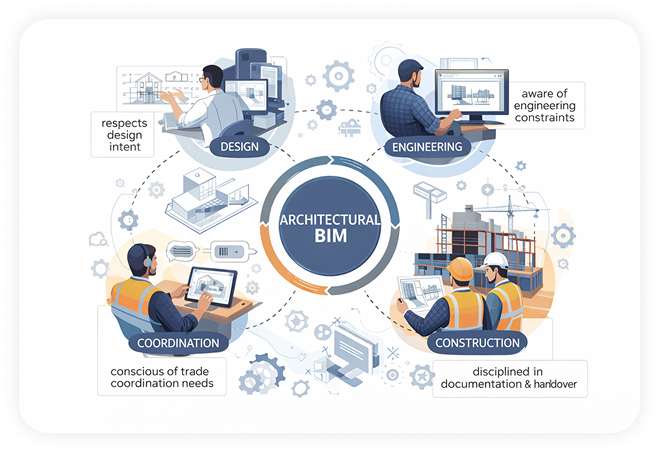
Architectural BIM does not belong to one team.
It sits at the intersection of design, engineering, coordination, and construction.

THE CURRICULUM
What You’ll Work through.
Architectural BIM Setup With Collaboration in Mind
Architectural BIM must be structured for shared project work — not just internal design.
You’ll work through:
organizing architectural models so they are readable and dependable
setting up levels, grids, and views that support coordination
understanding how early architectural decisions affect engineers and downstream users
01
Setup for Collaboration
Why this matters:
Early setup decisions shape how smoothly the entire project team can collaborate.
Developing Architectural Models as Shared Information
Modeling goes beyond geometry when multiple disciplines rely on your work.
You’ll work through:
building architectural elements with consistency and intent
understanding how architectural information is consumed by other teams
maintaining clarity as models evolve and complexity increases
02
Shared Information Modeling
Why this matters:
Architectural models are reference points for the entire AEC team.
Managing Architectural Information & Views
Architecture carries responsibility for spatial clarity and data reliability.
You’ll work through:
organizing views for different project audiences
managing rooms, areas, and architectural data meaningfully
controlling visibility and graphics to communicate intent clearly
03
Information & View Control
Why this matters:
Clear information reduces misinterpretation across disciplines.
Multi-Discipline Coordination
04
Architectural BIM in a Multi-Discipline Environment
Architecture never works alone.
You’ll work through:
preparing architectural models for coordination use
understanding how architectural decisions impact structure and MEP systems
responding to coordination inputs without degrading model quality
Why this matters:
Strong architectural BIM enables smoother coordination for everyone.
Translating Models Into Reliable Architectural Deliverables
Models must ultimately communicate clearly through documentation.
You’ll work through:
producing drawings that communicate intent across teams
maintaining consistency between model and documentation
preparing schedules that support design and coordination decisions
05
Documentation & Delivery
Why this matters:
Clear documentation reduces confusion, RFIs, and rework.
Quality Control & Professional Architectural Delivery
Professional BIM is defined by accountability.
You’ll work through:
reviewing architectural models for accuracy and readiness
identifying issues that impact other disciplines
preparing architectural outputs for sharing and handover
06
Quality Control & Handover
Why this matters:
Reliability builds trust across the AEC ecosystem.
WHAT YOU GRADUATE WITH
What Your Architectural Work Signals to the Industry
Your portfolio is designed to show how your architectural BIM behaves inside real AEC projects — not just how it looks.
-
Your work shows structured models, readable drawings, and consistent organization that teams can navigate easily.
-
Your architecture supports engineers and trades with clear spatial intent and dependable information.
-
Your work reflects how design changes are absorbed without breaking model logic or documentation clarity.
-
Your drawings and schedules convey intent clearly across multiple stakeholders — not just designers.
-
Reviewers see control, discipline, and awareness of downstream impact — not just software output.
CAREER IMPACT
Where Architectural BIM Capability Creates Real Value
Architectural BIM skills matter wherever projects rely on clarity, coordination, and shared information.This program prepares you to contribute meaningfully across the AEC ecosystem — not just within one role or one type of organization.
Design & Architecture Practices
01
Apply architectural BIM to support design development, documentation, and collaboration — ensuring design intent is clearly communicated and carried through project stages.
Engineering & Multi-Discipline Teams
02
Enable smoother coordination by providing architectural information that engineers and consultants can rely on for planning and system integration.
General Contractors & Digital Delivery Teams
03
Support coordination, constructability reviews, and documentation workflows by delivering architectural BIM that holds up under real project conditions.
Specialist BIM & VDC Groups
04
Contribute to teams focused on model coordination, information management, and digital project delivery across complex projects.
Global & Remote Project Environments
05
Work confidently with distributed teams and international clients who expect structured models, clear documentation, and professional collaboration habits.
What matters most is that you understand how architecture enables collaboration across the entire project lifecycle.

Ready to Build Architectural BIM
That Teams Can Rely On?
If you want to move beyond tools and learn how architectural BIM actually works across design, engineering, coordination, and delivery —this program gives you the structure, mindset, and project experience to do exactly that.
You don’t need to know everything before you start. You need the right framework and the right guidance.